Last updated November 18, 2026



Free written scope consultation - allowances, timeline, and change-order rules on paper before a single trade is scheduled
Driveway & Pavers Troubleshooting in Vallejo: Common Problems and How to Fix Them
If your pavers are sinking in the same spot every rainy season, re-leveling them without addressing sub-base drainage is the equivalent of re-painting over mold. It looks fixed until it doesn’t. Nine times out of ten, a failing Vallejo paver driveway is misdiagnosed: homeowners patch the surface when the real problem is a compromised base, a drainage conflict, or the wrong joint material for our wet winters and dry summers. This guide walks you through the three failure types, how to tell them apart, what each repair involves, and where the line falls between a cosmetic fix you can handle and a repair that needs a licensed contractor.
Quick Answer
Most sinking, rocking, or cracking pavers in Vallejo are caused by one of three things: base failure (the compacted gravel and sand layer under the pavers has settled or washed out), drainage failure (water pooling against the house, garage, or curb instead of running off), or normal settling from soil movement and tree roots. Re-leveling the surface without fixing the cause buys you one dry season at best. The correct fix depends on which failure you have, and identifying it correctly is the difference between a patch that lasts and one that comes back.
Styles & brands we work with
- Kitchen remodeling
- Bathroom remodeling
- Home additions & ADU
- Roofing
- Windows & doors
- Driveway & pavers
- Fence
Table of Contents
- How to Tell Base Failure, Drainage Failure, and Settling Apart
- Why Edges Fail First at Garage Aprons and Curb Cuts
- What Efflorescence and Joint Sand Washout Are Telling You
- Tree Roots from Mature Street Trees: Diagnosis and Options
- Cosmetic Repairs vs. Structural Repairs
- How a Proper Paver Repair Actually Goes
- Keeping a Vallejo Driveway Sound Through Wet and Dry Seasons
- Common Mistakes to Avoid
How to Tell Base Failure, Drainage Failure, and Settling Apart
These three problems look similar from the driver’s seat but require completely different repairs. Getting the diagnosis wrong is the single most expensive mistake we see on driveways around Vallejo.
- Base failure: Pavers rock underfoot, joints open in a repeating pattern, and depressions stay put regardless of weather. The compacted aggregate base has lost its load-bearing ability, usually from poor initial compaction or water that reached the subgrade.
- Drainage failure: Water pools or runs toward the house, garage, or a low spot and drains slowly after rain. Depressions are worse in the wet season and may improve in dry months. Staining, moss, or muddy joint sand point to this.
- Settling: A slight dip that develops gradually, often in one area, with pavers that still feel solid. Common where backfill trenches cross the driveway or where soil was disturbed before the pavers went down.
Here’s the test: after a solid rain, watch where water stands. If it lingers 24 hours later and the pavers below it rock, you likely have both drainage and base problems stacked on each other. That combination is why a simple re-sand never holds. In our experience, a driveway that pools against the garage apron and also rocks in the middle needs the base opened and re-graded with proper drainage established before anything goes back down.
When we assess a paver driveway as part of our driveway & pavers work, we check base condition with a probe and a level survey of the slope before recommending any repair. Skipping that step is how homeowners end up paying twice.
Why Edges Fail First at Garage Aprons and Curb Cuts
Edges are the most common failure point on Vallejo paver driveways because they take the most concentrated load and see the most water. The garage apron takes the full weight of turning tires, and curb cuts collect runoff from the street. Both spots are where restraint systems get skipped or installed too lightly.
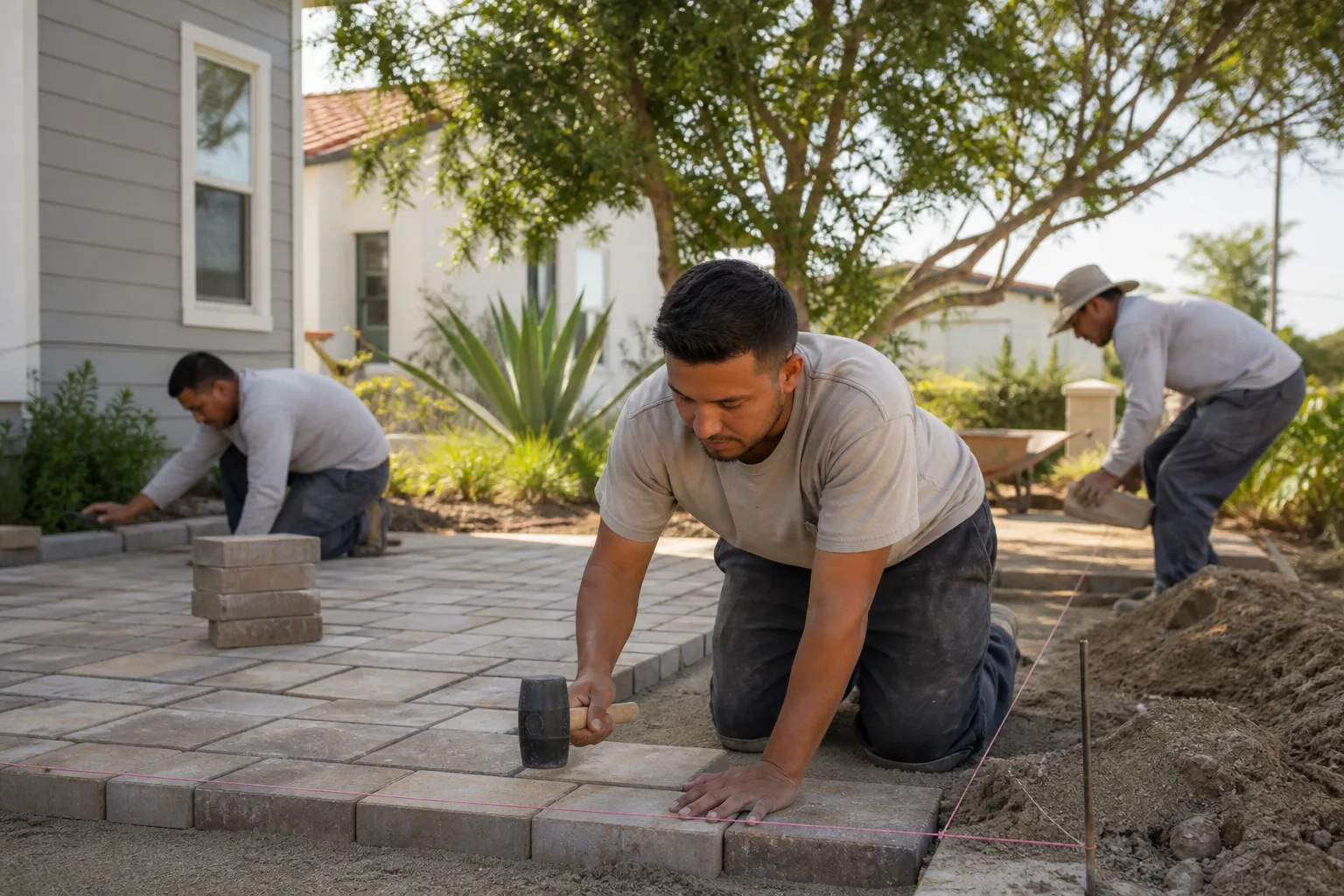
A paver field is only as good as its edge restraint. Without a proper restraint, pavers creep outward over time, joints open, and the whole field loosens. The right way to retrofit an edge restraint follows a specific sequence:
- Excavate a trench along the failed edge, exposing the paver field’s cut course.
- Remove loose pavers and any failed base material down to solid compacted aggregate.
- Re-establish the base with compacted aggregate, then re-bed with sand.
- Install a rigid edge restraint – spiked or adhesive-set, matched to the paver thickness – and lock it to the base.
- Re-set the pavers, compact the field, and re-sand the joints.
At garage aprons and curb cuts specifically, restraint also needs to resist lateral push from turning wheels and water flow. That’s often a stronger restraint than what was originally installed. If your pavers are spreading at the apron or shifting at the curb cut, the fix isn’t to push them back – it’s to replace the restraint and re-establish the base beneath that edge.
What Efflorescence and Joint Sand Washout Are Telling You
A white, chalky film on your pavers is called efflorescence. It’s mineral salt drawn to the surface as moisture moves through the concrete. On its own, it’s harmless. What it signals is more useful: water is passing through the paving system where it shouldn’t, either through the joints or from beneath. In a Vallejo driveway, that’s a tell about how the original installation handled water.
Joint sand washout is the companion symptom. When you see sand collecting at the bottom of the driveway after rain, or the joints opening in a wide band, you’re losing the interlock that keeps the whole field tight.
Here’s how to tell whether cleaning or re-grouting is the answer:
- Cleaning is enough when efflorescence is light, joints are intact, and no pavers rock. A proper efflorescence cleaner applied correctly and rinsed will address the appearance. Sealing afterward helps slow it from returning.
- Re-sanding with a stabilized joint material is the answer when joints have opened but the field is solid. Polymeric or stabilized joint material holds better against washout than plain sand.
- Re-grouting or joint replacement is the answer when washout is severe, joints are wide and uneven, and pavers have started to shift. At that point the interlock has failed and re-sanding alone won’t restore it.
Efflorescence that keeps returning after cleaning and sealing is usually a sign that water is still entering the system. That means the fix is at the base or drainage layer, not the surface.
Tree Roots from Mature Street Trees: Diagnosis and Options
Vallejo has a lot of mature street trees, and their roots are a frequent cause of paver heaving and cracking. A root doesn’t need to push up much to open joints and break interlock. It’s more often a gradual lift that shows up as a raised band across the driveway with cracks running perpendicular to it.
Diagnosis is usually straightforward: the heaved area traces back to a tree, and the lift moves outward from the trunk. When you dig beside the heaved pavers and find a root an inch or more across traveling under or beside the field, you’ve found the cause.
Your repair options, in order of how much driveway gets rebuilt:
- Root pruning, if done correctly: A certified arborist can sometimes cut a specific root that’s causing the lift, provided it doesn’t threaten the tree’s stability. This is a decision for the arborist, not the paver contractor alone, and the wrong cut can kill a mature tree.
- Root barrier and local rebuild: Where root removal is safe, install a root barrier along the affected edge and rebuild the lifted section on fresh base. This is the most common fix we do for tree-related paver issues in Vallejo.
- Root bridge or structural overlay: In cases where the root can’t be cut and the tree has to stay, the paving system can sometimes be re-engineered to carry over the root zone without putting weight on it.
- Partial removal and re-route: Rarely, the driveway path itself needs adjusting to go around the root zone. This is a bigger job and worth comparing against the alternatives before committing.
Full removal of the entire driveway is almost never necessary for a tree root problem. The typical fix is localized: identify where the root is, treat it right, and rebuild the affected section.
Cosmetic Repairs vs. Structural Repairs
This is the line that matters most to your wallet. Some paver problems are surface issues you can address without a contractor. Some are structural and need to be done right the first time.
Cosmetic repairs you can do yourself (assuming no rock, no pooling, and no joints wider than a quarter inch):
- Cleaning efflorescence with an appropriate cleaner and re-sealing.
- Replacing a handful of damaged or stained pavers in a solid field.
- Re-sanding joints with a stabilized joint material after a light washout.
- Cleaning moss and algae from shaded or north-facing sections.
Structural repairs that need a licensed contractor:
- Pavers that rock underfoot, sink in the same spot, or heel in one area.
- Joint gaps wider than about a quarter inch, or a recurring gap pattern.
- Heaving, lifting, or cracking that traces to a tree root or a failed edge.
- Water pooling against the house, garage, or any low spot that doesn’t drain within 24 hours.
- Pavers shifting at the garage apron, curb cut, or against a wall.
There’s a warranty angle to this too. Many paver installers warrant their base build. If you open the field, dig out base, or reset pavers yourself, you can void that warranty. Before you go digging, check the original installer’s terms. If your pavers are covered, call the original installer first. If not, that’s when a structural repair quote makes sense.
How a Proper Paver Repair Actually Goes
A repair done right follows the same logic as a new build: fix what’s under the pavers before you put the pavers back. Here’s the general sequence we follow when rebuilding a failed section of paver driveway.
- Assess and mark the failure zone. Probe, level, and watch water behavior to confirm base vs. drainage. Mark the full area affected – narrowing the repair zone to the visible dip is how it comes back.
- Lift the affected pavers and set them aside. In a properly bedded field, most pavers come up intact and can be re-laid.
- Excavate down to stable subgrade. Remove failed base material until you hit firm, compacted soil or aggregate. This is the step amateurs skip, and it’s why surface patches fail.
- Re-establish base and drainage. Rebuild the aggregate base in compacted lifts, re-establish the slope away from the structure, and add drainage where water was pooling.
- Re-set edge restraints where the repair zone hits an edge. Any failed restraint in the affected area gets replaced, not just re-set.
- Re-bed, re-set the pavers, and compact. Bedding sand, pavers, compaction in that order.
- Re-sand joints with a stabilized or polymeric material. Plain sand washes out too easily in Vallejo winters.
- Seal if specified. Not every driveway needs sealing, but it’s the right call in specific situations (efflorescence history, heavy shade, high traffic).
Material choice matters here too. When we re-lay pavers, we work with specified product from Belgard, Unilock, and Techo-Bloc so the replacement pavers match the field, not just the color name.
Keeping a Vallejo Driveway Sound Through Wet and Dry Seasons
Vallejo swings between wet winters and long dry summers. That cycle moves soil, and the movement is what stresses a paver system. You can’t change the weather, but you can keep the system handling it.
- Keep joints topped up. Re-sand with stabilized joint material when the joints drop below the paver surface. Late fall, before the rains, is the right time.
- Keep water moving away from the house and garage. Clean out the gutter downspouts and check that splash blocks carry water off the driveway, not onto it.
- Watch the edges. Any gap at the apron, curb cut, or wall edge gets addressed early. Edges fail first because they take the most load.
- Address efflorescence early. A light clean and seal in fall costs less than a rebuild after a winter of water crossing the joints.
- Don’t seal too soon after installation. New pavers need curing time before sealing. If your driveway was recently installed, confirm the installer’s sealing recommendations before doing it yourself.
Our technicians have up to 15 years of experience with paver systems in this climate, and the pattern is consistent: the driveways that hold up are the ones whose owners re-sand and watch drainage every fall.
Common Mistakes to Avoid
- Re-leveling without fixing drainage. If the water was pooling before, it’ll pool again after. The pavers will re-sink in the same spot within a season or two.
- Adding sand over a hollow spot. This hides the problem temporarily and makes the eventual repair bigger. If the pavers are rocking, the base underneath is the issue, not the surface.
- Cutting tree roots without arborist input. Cutting the wrong root can destabilize a mature tree and create a much bigger problem than the driveway repair was.
- Skipping edge restraint replacement. If you’re already rebuilding the edge, put in a proper restraint – re-setting old, failed restraint guarantees the edge fails again.
- Using plain sand for joint re-sanding in Vallejo. Plain sand washes out in the first wet winter. Stabilized joint material is worth the small difference in cost.
- Opening the field before checking the warranty. A DIY repair can void the installer’s warranty on the base build. Read the terms first.
- Sealing a failing driveway to hide the symptoms. Sealing a failing field just traps the water that’s already causing the problem.
When to Call a Professional
Call a licensed contractor when you’ve got rocking pavers, recurring depressions in the same spot, joints wider than a quarter inch, heaving or cracking that traces to a tree root, or water pooling against your house or garage. These are structural issues, and a surface patch won’t hold through a Vallejo wet season. If you’re unsure which category your driveway falls into, a proper assessment settles it quickly. Construction Vallejo offers free estimates in Vallejo and can tell you what your driveway actually needs, not just what’s visible on the surface. Call (844) 684-1772. We answer 24/7. Fast dispatch from 7am to 7pm, Sunday through Friday.
See the difference
 Before
 After
 Before
 After
 Before
 After
Frequently Asked Questions
Cost depends on which of the three failure types you have. A cosmetic re-sand and a full base rebuild of a failed section are very different jobs, and the repair zone size drives most of the estimate. Surface-only fixes are the least expensive and usually the shortest-lived. Get a written, line-item estimate from a licensed contractor so you can see exactly what work is included. Call (844) 684-1772 for a free estimate in Vallejo.
Yes. Most paver repairs are localized – the damaged section gets lifted, the failed base is rebuilt, and the pavers are re-laid. Full removal is almost never necessary unless the failure has spread across the entire field. A proper assessment marks the full affected zone so the repair isn’t narrower than the problem. Call (844) 684-1772 to schedule a free estimate.
Because the cause under the pavers hasn’t been fixed. Water is reaching the base layer at that spot, so the base keeps settling and the pavers keep sinking. Re-leveling without addressing the drainage and base at that location just re-runs the loop. The fix is to open the base, find the water path, and rebuild – which is what a licensed contractor should do. Call (844) 684-1772 for an assessment.
White chalky stains are called efflorescence – mineral salt drawn to the surface by water moving through the pavers. It’s harmless to the pavers, but it’s a signal that water is passing through the system where it shouldn’t. Light efflorescence usually responds to a proper cleaner. Recurring efflorescence after cleaning points to a water entry problem that needs to be fixed under the surface. Call (844) 684-1772 to have it looked at.
Yes, and that’s the common case. A single root lifting pavers along one band of the driveway is usually a localized repair – a certified arborist determines whether the root can safely be cut, then a root barrier and rebuild fix that section. Full driveway removal is rarely needed for tree root damage. Call (844) 684-1772 for a free estimate on a root-related repair.
No. We’re closed Saturday and open Sunday through Friday, 7am to 7pm. If you’re calling on Saturday to schedule a paver assessment, a call outside dispatch hours is booked into the next opening, Sunday through Friday, 7am to 7pm. Call (844) 684-1772.
The Bottom Line
Most failing paver driveways in Vallejo get the wrong repair once before they get the right one. The takeaway from this guide is simple: diagnose before you patch. Base failure, drainage failure, and settling each have a different fix, and treating one as another is why so many repairs come back within a season or two. Fix the edges, keep joints topped with stabilized sand, address efflorescence early, and let a licensed contractor handle anything that rocks, heaves, or pools. If your driveway has crossed from cosmetic to structural, get a written estimate before you spend anything on a surface patch.
Where This Fits With the Rest of Your Property

A driveway isn’t isolated from the rest of the property. Drainage from the roof, the slope of the yard, and the grade at the property line all influence how water reaches your pavers. If your driveway problems keep returning, it’s worth looking at the whole picture – the roof that dumps water at the apron, the grading, the edges. Construction Vallejo works across the full property, including Construction Vallejo, so the drainage fix and the paver fix happen as one plan instead of two contractors pointing at each other. When a fence line, drainage correction, or hardscape change is part of the same project, that coordination is what keeps the driveway repair from coming undone.
If your driveway repair is part of a larger scope, we also handle fence installation and home additions & ADU projects without handing the relationship to a different contractor for each trade. The full-property scope is what a cohesive repair plan looks like: one plan, one contractor, one set of decisions.
Contact
If your paver driveway is sinking, cracking, or holding water in the same spot every rainy season, the first step is a proper diagnosis, not a surface patch. Call (844) 684-1772 for a free estimate in Vallejo. We answer 24/7. Fast dispatch from 7am to 7pm, Sunday through Friday. Closed Saturday.
Written by the team at Construction Vallejo.